
Many educational tools, research databases, and even certain academic journals are restricted, preventing users from obtaining vital information. Instead of directly accessing websites, users interact with a video-streamed version of the browser, making it harder for network filters to detect and block internet activity. We’ll also explain why Incogniton is a smarter alternative to VPNs when it comes to private, undetectable browsing.
Incogniton’s 8 proxy countries allow users to exercise their right to information without fear of surveillance or restriction. In some regions, governments enforce strict internet censorship, blocking access to social media platforms like YouTube, Twitter, and Facebook, as well as independent news outlets. For instance, a show available on Netflix to South Korean users may not be accessible in the United States. Many streaming services and online platforms limit access based on geographic location. Incogniton’s unblocked browser offers a versatile solution for bypassing online restrictions while maintaining privacy. In summary, VPNs are great for encrypting all device traffic but Incogniton offers a quicker, more reliable, and flexible way to bypass internet restrictions without detection.
What Is Chrome Incognito Shortcut & How To Use It
You can also use private browsing to troubleshoot potentially problem extensions. And remember, private browsing is useful for more than just privacy. To close out of incognito, tap the box with the number in it (indicating how many tabs you have open) and go back to a non-private tab, or simply close the incognito tab(s).
How To Turn On Incognito Mode & Start Private Browsing
Although it might seem reasonable that a browser’s end game would be to craft a system that blends incognito modes with anti-tracking, it’s highly unlikely. That’s because private browsing is intended to wipe local traces of where you’ve been, what you’ve searched for, the contents of forms you’ve filled. To enable incognito mode on your mobile device, keep reading! Once you close your incognito tab, any downloads or pages viewed will be erased from your history. To activate incognito mode on Chrome for your desktop, start by opening Chrome and clicking the 3 vertical periods in the top right corner of the screen.
Chrome, Edge Kick Off Faster Release Cadence; Enterprises Can Skip Versions
- There are two ways to search incognito, and it’s more straightforward than setting up a VPN on a router.
- Open the properties of the Internet Explorer shortcut that you created, and go to the Shortcut tab.
- Open current tab in an Chrome incognito Mode.
- To open an incognito tab on Chrome on IOS or Android, tap the three dots and select New Incognito Tab.
Then, in the Target field, type -private-window after the closing quotation mark with the path towards the firefox.exe file. Implementations of the HTML5 FileSystem API can be used to detect users in private mode. Bugs and security vulnerabilities in extensions themselves may also leak personally identifiable data from private mode. This is usually why some people mistake private browsing for a virtual private network. In this mode, the browser initiates a temporary session separate from its main session and user data.
The new Incognito window can be recognized by the dark background and the stylized “spy” icon just to the left of the three-dots menu. But the mode remains a useful tool whenever the browser — and the computer it’s on — are shared. Use limited data to select content. Understand audiences through statistics or combinations of data from different sources. Use limited data to select advertising. In the Opera mobile app, on Android, tap the tabs button, swipe to Private, and tap the plus sign.
Activating Private Browsing In Mozilla Firefox
Is there a way (except click-right → Open Link in Incognito Window) to make Google Chrome open all links in an incognito window from normal browsing mode? If you open another tab in Incognito mode, your private browsing session continues in the new tab. In December 2023, Google settled a $5 billion consumer privacy lawsuit that alleged that its practices allowed it to track users in private browsing mode in various browsers. The gathered data proved that the browsers' private mode implementations cannot fully hide users' browsing activities and that browsers in private mode leave traces of activities in caching structures and files related to the paging process of the operating system. It is a common misconception that private browsing modes can protect users from being tracked by other websites or their Internet service provider (ISP). Private browsing (also known as incognito mode or private mode) is a feature in most web browsers that enhances user privacy.
How To Open The Google Chrome Incognito Mode
Close a Private Window just as any Safari window, by clicking the red dot in the upper left corner of the browser frame. Otherwise, a window can be called up by selecting the File menu and clicking on New Private Window. (If the destination site doesn’t support HTPPS, Firefox will recognize this and go into fallback mode, connecting via HTTP instead.) While the earliest version of this was offered only inside Private Windows, the expanded technologies also work within standard mode. To close a Private Window, shut it down just as one would any Firefox window by clicking the X in the upper right corner (Windows) or the red dot in the upper left (macOS).
How To Activate Incognito Mode In Google Chrome
From here, click “New incognito window” to prompt a new Chrome window to open in incognito mode. All the popular browsers have a private browsing or incognito feature, and they’re so easy to turn on. If you want to browse online but don’t want other people to see the sites you’ve been visiting, an incognito window helps keep your history a secret.
Chrome may get far more attention for its Incognito than any other browser — no surprise, since it’s by far the most popular browser on the planet — but Apple’s Safari was actually the first to introduce private browsing. Because Enhanced Tracking Protection is enabled by default within Firefox, it doesn’t matter which of its settings — Standard, Strict or Custom — is selected as far as private browsing goes; everything that can be blocked will be blocked. A private session window is marked by the purple “mask” icon in the title bar of the Firefox frame. Once a tab in Incognito has been filled with a website, Chrome continues to remind users that they’re in Incognito by the dark background of the address bar and window title. It’s much easier to turn on some level of anti-tracking by default than it would be to do the same for private sessions, as evidenced by the number of browsers that do the former without complaint while none do the latter.
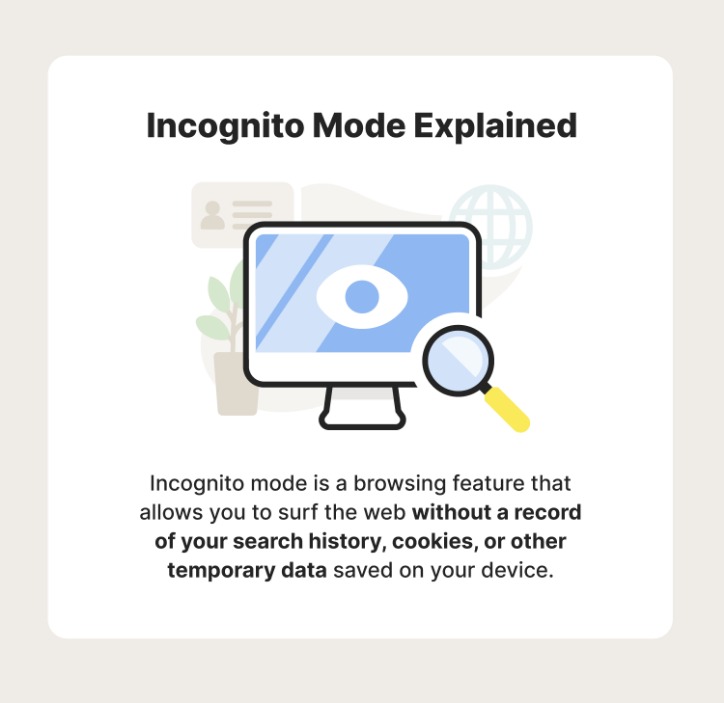
Scripts have also been developed to detect private browsing mode on other browsers, such as Firefox. Brazilian researchers published the results of a project in which they applied forensic techniques (namely the Foremost data carving tool and Strings program) to extract information about the user's browsing activities on Internet Explorer and Firefox browsers with their private mode enabled. In a survey conducted by DuckDuckGo, 48% of participants chose not to respond, prompting lead researcher Elie Bursztein to observe, "Surveys are clearly not the best approach to understand why people use private browsing mode due to the embarrassment factor." Additionally, 18% of respondents indicated that their main use of private browsing modes was for online shopping. Furthermore, there is a possibility that identifiable traces of activity could be leaked from private browsing sessions by means of the operating system, security flaws in the browser, or via malicious browser extensions, and it has been found that certain HTML5 APIs can be used to detect the presence of private browsing modes due to differences in behavior. The primary purpose of these modes is to ensure that data and history from a specific browsing session do not remain on the device or get accessed by another user of the same device.
Keep reading, and we’ll walk you through how to open incognito tabs on any device using browsers like Google Chrome, Safari, and Firefox. This data is deleted when you close the private tab. In Firefox, incognito mode is known as Private Browsing.
On Safari for iPhone or iPad, tap the tabs button and swipe to Private, or choose it from the three-line menu. You can switch between Incognito tabs and regular Chrome tabs.
Opening links in Incognito Mode varies slightly depending on the web browser you are using. However, it’s important to remember that while Incognito Mode provides enhanced privacy, it does not make you completely anonymous online. This helps ensure that your website functions as intended and provides a seamless browsing experience for all visitors. However, by opening links in Incognito Mode, you start with a clean slate, and these restrictions do not apply. Opening links in Incognito Mode offers several advantages and can be beneficial for various reasons.
What To Expect In Incognito Mode
To quickly enter incognito mode in Chrome, press Ctrl+Shift+N on Windows or Command+Shift+N on Mac. Discover easy steps and keyboard shortcuts to browse privately across different web browsers To exit Incognito mode, close all Incognito windows. Unlike other browsers, Safari’s warnings about online activity are more concise and do not include cautions about visible online traces. To access a Private Window on Safari, users can use the Command-Shift-N shortcut or choose the option from the File menu. Alternatively, you can open a private window by clicking on the three horizontal lines at the top right corner of Firefox and selecting New private window.
It’s important to note that while Incognito Mode provides a certain level of privacy, it does not make you completely anonymous online. This makes it particularly useful when using public computers or shared devices, where you may not want your browsing habits to be visible to others. Additionally, opening links in Incognito Mode can be beneficial when you want to perform a search or visit a website without it affecting your personalized search results or recommendations. It provides a layer of privacy and anonymity, ensuring that your online actions remain confidential. Gregg Keizer covers Windows, Office, Apple/enterprise, web browsers, and web apps for Computerworld.